|
Douglas Njegovan, Yoram Gross EM. TV Studios
(June 2006)
For thirty-seven years, Sydney-based
Yoram Gross-EM.TV (Yoram Gross) has been
delighting audiences with outstanding animated fare. Internationally
recognized as Australia's leading producer of quality children's and family
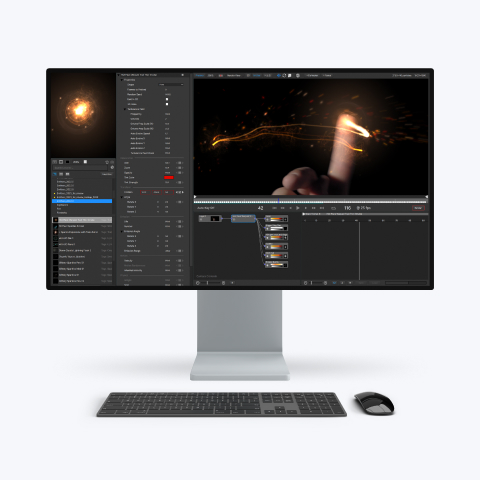
entertainment, the veteran studio has been using wondertouch particleIllusion
software to create a broad spectrum of particle effects on various
international television hit series including the company's flagship "Blinky
Bill," "Seaside Hotel," "Flipper & Lopaka," and "Tabaluga," among others.

The Yoram Gross production pipeline is predominantly based on the Macintosh
platform. particleIllusion 2.0.5 was first adopted into the studio's special
effects department in 2001. The latest version of the software,
particleIllusion 3.0 for Mac OS X, is presently installed on Mac G5 Dual 2
GHz computers, and is used in conjunction with Adobe After Effects for
tracking, matting and compositing with existing animation.
Douglas Njegovan, 3D SFX animator at Yoram Gross and long time user of
particleIllusion comments, "As an early particleIllusion beta tester, I had
preliminary insight into the development of the product and slowly began to
integrate it more and more into our productions. As the creative team started
to become more familiar with its capabilities, we have been able to do more
CG special effects work in the same or less amount of time. The introduction
of particleIllusion 3.0 for the Mac OS X last year was an eagerly anticipated
release for our platform of choice, and it has become an indispensable
production tool."
Effects work at Yoram Gross consists of a mix that requires creating effects
from scratch, adding elements to traditional animated effects to reach the
final desired look or simply enhancing an existing 2D effect.

"Our special effects department sits between the compositing and post/editing
departments," notes Njegovan. "Typically, the effects process begins when an
art director assigns scenes that will involve visual effects shots. Scenes
get sent to the compositing department where they undergo normal fix-ups and
adjustments. The scenes are then sent to the special effects department for
final completion.
"Much of the time, traditional animated layers are not drawn but the whole
effect is computer generated. These shots are imported into After Effects
where particleIllusion effects are composited together with 2D animation.
Other times we have already animated the effect in 2D but it requires final
polish. The resulting material is rendered and transferred to our Final Cut
Pro editing suites," he says.
Animated particle effects at Yoram Gross range
from prominent effects such as water, snow, rain, dust and smoke and all
sorts of lighting effects to secondary animation scene fillers such as
blowing leaves, floating debris, plant life, mist and clouds. As in any
complex CG production Njegovan says the main challenges for effects artists
involve marrying different sources into one scene that help convey the story
and don't take away viewers attention.

"Being able to match the effects design to our characters and background
painting style and making sure that an effect appears seamless in the
sequence is something we've been successfully able to do to using
particleIllusion and After Effects on a number of projects," adds Njegovan.
"We take special care so that the effects do not overpower characters and
action but enhance the overall experience. Because the particleIllusion
emitter library is so easy to customize with our own source artwork, it
genuinely helps us convey the feeling that all imagery comes from the same
source," he says. "particleIllusion's robust keyframing tools and ability to
import a wide range of image and movie files as a background layers helps us
to successfully complete more challenging shots involving camera motion and
character tracking."
Njegovan explains that particleIllusion has been in
widespread use the past four-and-a-half years on several children's animated
television series including, "Seaside Hotel," now going into its second
season being co-produced with Yoram Gross' French partner, "Télé Images Kids.
It was also used to produce 13, 24-minute episodes based on a collection of
children's books called, "Deadly!" Other Yoram Gross programs that have
relied on particleIllusion include "Tabaluga," a series in its third season
chronicling the adventures of the last dragon left on earth and his adversary
an evil snowman, and "Flipper and Lopaka," an action/comedy adventure about
Flipper the dolphin and his human friend Lopaka, also in its third season.
"Leveraging particleIllusion on "Tabaluga" allowed us full creative license
in developing light and transform elements, snow storm sequences, magical
effects, water and light, dust and smoke," says Njegovan. "During season
three of "Flipper and Lopaka," more visual effects shots per episode were
added as well as the introduction of 3D props composited with 2D animation.
With access to particleIllusion's more than 1500 preset emitters there is an
endless supply of presets for us to start with and we were able to easily
incorporate changes quickly without affecting production schedules."

Yoram-Gross also used particleIllusion during the 2005 holiday season to
create a wide range of effects for a "Blinky Bill's White Christmas," a
feature length television episode made specifically for Channel 7 Australia;
broadcast on Christmas Eve.
"In general, particleIllusion helps us create
effects either by complementing 2D animation or during post-production where
things become obvious in the final cut," says Njegovan. "In a busy studio
like ours where time is short, particleIllusion's speed is a real asset.
particle Illusion is not only the fastest particle generator I've ever used,
but it offers great versatility and ease of use which allows you to go from
effect to effect in just couple of clicks.
|