Company: Zen Films
www.zenfilms.com
Challenges
  • Imaginatively generate particle effects to create brooding, atmospheric effects and accentuate the film's dark vision.
  • Communicate complex ideas rather than something endemic to the physical world.
Solution
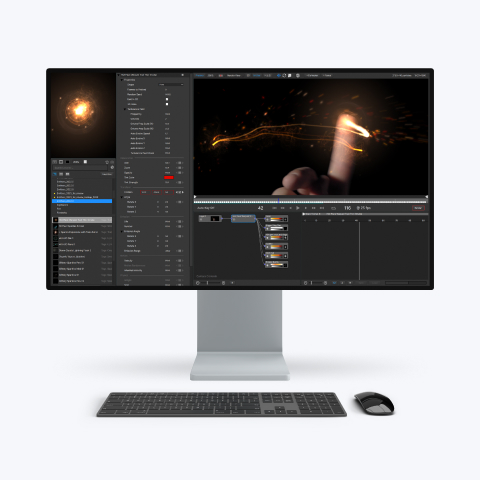
  • Use particleIllusion 3.0 to add stylized flames, waves of UV energy, and steam emanating from a human body.
  • Use particleIllusion to track an emitter sequence with the moving background clip.
  • Import particleIllusion image sequence back into After Effects, and drag into an AE composition for final mastering.
Benefits summary
  • Saved time and money in the creation of both realistic and fantastical effects in one piece of software
  • Handled manipulation of particleIllusion's emitter properties, particle weights, and opacity easily with shots posted to After Effects in HD resolution.
Toolkit
  • particleIllusion 3.0
  • particleIllusion Pro Emitter Libraries: "Eclectic 1&2,"Graphics Elements 1&2," and "Extreme Graphics"
  • Alienware PC with Quad AMD CPUs
  • Adobe Production Suite
  • Adobe After Effects

Zen Films: Mindflesh

(Feb 2008)

Zen Films' Robert Pratten Uses particleIllusion to Create Visceral, Atmospheric Effects for Bloody Buddhist Thriller MindFlesh

To achieve and maintain the intensity required for MindFlesh, a new pscho-sexual thriller from independent production company Zen Films, director and writer Robert Pratten turned to particleIllusion, the award-winning, standalone particle effects application from wondertouch to create brooding, atmospheric effects and accentuate the film's dark vision.

Based in working-class London, MindFlesh introduces Chris (Peter Bramhill), a mini-cab driver whose visions of his fantasy woman (Carole Derrien) become so strong as to make her physically real. In order to produce visual effects at once realistic and sufficiently surrealistic for such a scenario, Pratten and his team used particleIllusion to create realistic smoke and fire effects, as well a spectacular realization of one characters' mental fantasies.

"We needed a solution for realistic effects, but we also needed effects that communicated complex ideas," says Pratten who co-founded Zen Films with wife Helen in 2000. "particleIllusion proved to be the ideal tool for both. I simply could not have made this film without particleIllusion. Any time you see smoke, steam, fire, flame, or any other graphic effect in MindFlesh, particleIllusion was crucial to its creation.

"It's a bit grisly, for example, one character appears to burn to death within a circle of ultraviolet lights," he says. "Luckily, it only happens in her mind, but we needed to portray the scene in a compelling way. While the actors only saw a circle of household fluorescent tubes, I was able to use particleIllusion to add stylized flames, waves of UV energy, and steam emanating from her body. I perfected the effects in particleIllusion before sending them into Adobe After Effects for finishing. The process worked flawlessly in enhancing and coloring the glow on her body."

Creating a realistic burning human is enough of a challenge, but conveying a state of hellish torment is quite another. To create what he calls a "supernova of the mind," Pratten found particleIllusion to be once again the ideal tool for the job.

"We wanted effects that would communicate deep, complex ideas rather than something endemic to the physical world," he explains. "particleIllusion enabled us to create both realistic and fantastical effects in one piece of software."

To create "The Red Site," a flaming red torture chamber complete with an altar of sacrifice, Pratten used particleIllusion to create a plethora of fire effects, as well as add what he calls an "ethereal energy force" overlooking the scene.

"I created a graphic disturbance on some computer screens, and overlaid some elements created with modified Pro Emitters to create the feeling of a pervasive higher intelligence," he explains.

Zen Films uses particleIllusion 3 on an Alienware PC with Quad AMD processors and, considering the results, a relatively modest 2GB of RAM. For MindFlesh, the company made most use of the Pro Emitter Libraries "Eclectic 1 & 2", "Graphics Elements 1 & 2", and "Extreme Graphics".

"Our post production setup consists mainly of the Adobe Production Suite, and we mainly use After Effects in conjunction with particleIllusion," Pratten explains. "For MindFlesh, everything was mastered in After Effects at HD resolution. To use particleIllusion, I merely had to import sequences from After Effects as uncompressed AVI files. I particularly love it that I can easily use and manipulate particleIllusion's emitter properties, particle weights, and opacity. When I get the right particle look, I can track the emitter with the moving background clip. The particleIllusion image sequence is then imported back into After Effects and dragged into an AE composition for final mastering. Throughout, the system lets me work at full resolution, I can change the angle that the viewer observes the effect (e.g. fire viewed from above, left, right etc.), the smoke can be produced and wafted exactly as I need it to and it's all scalable."

Pratten faced another formidable atmospheric challenge when he encountered one of the film's more intense sex scenes. As the fantasy woman literally drains the life essence from the film's protagonist, Pratten had to find a way to convey the hero's rapid deterioration:

"The Goddess is literally 'loving' him to death," Pratten says with a smile. "His skin begins to dissolve in a gradual translucency that reveals his tissue and bone beneath. To create the most compelling, visceral visual, I used particleIllusion to create a kind of 'skin smoke' that emanates from his torso. I simulated the skin dissolve in After Effects, then tracked the particleIllusion emitter into the action, making sure that it was always precisely matched with the skin dissolve interface. The resulting effect is very subtle, but adds a crucial dimension of realism to the bizarre scene."

While the film itself plumbs the depths of the physical, mental, and spiritual worlds, Pratten was most intrigued with testing his own creative limits, which were significantly broadened by particleIllusion. For his part, Pratten is delighted to have found particleIllusion in time for his work on MindFlesh:

"MindFlesh is the first film where we've been so involved in the effects work," Pratten confesses. "As an artist first and foremost, I was really looking forward to seeing what I could create. We've used particleIllusion for the past 6 months, and I've fallen totally in love with the software. It's so easy to use and produces really great results. I particularly like that it's easy to modify other people's emitters to create something new with minimum amount of time and effort. I wouldn't have the slightest hesitation recommending particleIllusion to other filmmakers and visual artists. The system makes it significantly easier to achieve superior results straight out of the box. More than that, there are enough controls to really experiment and create truly original, innovative visual effects and striking cinematic moods. Even though I'm extremely satisfied with particleIllusion, I still feel like I've only scratched the surface of what it can do. This is the beginning of a beautiful friendship."