|
Mediastation
(Mar 2008)
Mediastation UK Fires up particleIllusion to Create Motion
Graphics and Atmospheric Effects for Live Multimedia Concert
Tours
Creating 3D devastation and destruction are recent themes that have
endeared the creative team at
Mediastation
to wondertouch particleIllusion
for the production of award-winning, super-charged animation, digital visual
effects and motion graphics work for film, video, concert tours, commercials
and multimedia presentations.
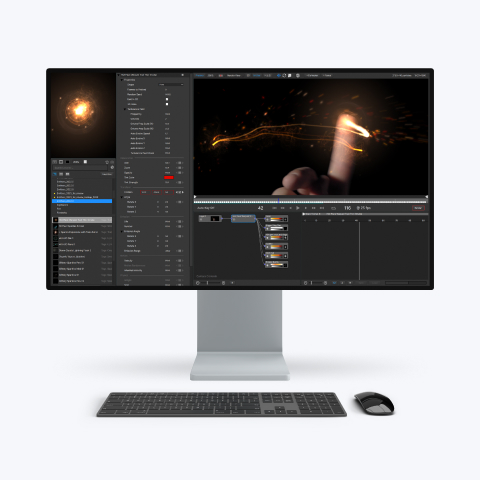
Based in Surrey in the U.K., Mediastation adopted wondertouch
particleIllusion 3.0 on Windows into the production pipeline in 2003 after
one of the effects team members downloaded a demo version of the software and
noticed how much more quickly smoke plumes and trails could be generated than
in the 3D package in use at that time. Since then, particleIllusion has
become a staple production tool at the facility and is used primarily for
pre-vis, motion graphics and compositing purposes. The Mediastation creative
team is also using several of wondertouch's Professional Emitter libraries.
 |
"We find the wealth of particleIllusion presets and the ability to easily
customize them, fast previews, and speedy render times are important features
that meet our content creation needs at Mediastation", says Andy Davenport,
VFX Supervisor at Mediastation. "particleIllusion is also easy to learn, and
we can get an inexperienced artist up-to-speed without a steep learning curve
so that they are creating effects elements very quickly."
|
Recent projects at Mediastation that have leveraged particleIllusion
extensively include the production of the immensely popular, 'Jeff Wayne's
Musical Version of The War of The Worlds LIVE!' concert tour; and ex-Pink
Floyd member Roger Waters "The Dark Side of The Moon Live" worldwide concert
tour, which began in 2006 and makes continued tour stops throughout 2008 in
U.S. and Europe. Mediastation is also credited with producing the
"first-ever" global advertisement in 3D cinema to promote the arrival of the
Red Bull Air Race World Series in London and is also known for a range of
cutting edge educational learning software produced in collaboration with its
partner company, Manic Monkey.
The 'Jeff Wayne's Musical Version of The War of The Worlds LIVE!' concert
tour is a staged musical and multimedia production of the classic album of
the same name; a retelling of the 1898 science fiction story by HG Wells.
The show features Jeff Wayne conducting the 10-piece Black Smoke Band and a
40-piece string orchestra, on-stage performers re-enacting scenes from the
story, a 3 ton, 32-foot high Martian Fighting Machine and 100-foot wide
screen projecting computer imagery.
particleIllusion was used extensively in the production of the 3D animation
and motion graphics - more than two hours worth of content -- for the touring
production which began in the UK in 2006, and continued to Australia, New
Zealand and again to the U.K in 2007. [Readers' note: The DVD of the show
immediately went Platinum and spent seven weeks at number one in the U.K. DVD
charts, and was the top selling music DVD in the U.K in 2007. The tour is
presently on hiatus and is scheduled to resume in 2009.]
Highlights of the production include a computer generated version of the late
actor Richard Burton's head that was lip synched to his original album
narration of "The War of the Worlds" in 1978. The presentation also features
actors in period costume who were filmed in a blue screen studio and
composited into many scenes, such as the crowds fleeing England on the steam
boat and soldiers attacking the invaders with cannons.
"With a team of six artists and just twelve weeks to complete the graphics
for the show, we had to work at breakneck speed to create the look of
devastation and destruction amidst a Victorian England landscape," said
Davenport. "particleIllusion was an enormous help creating effects such as
smoke, explosions, collapsing houses, cannon fire, water splashes, ship
wakes, foot stomps and the Martians green pod trails."
Projecting the finished concert tour graphics onto a 100-foot wide screen
posed rendering challenges. "In order to project graphics onto the large
screen required rendering images out at a resolution of 2700 x 576. Effects
that would have taken days to render in a 3D animation package took mere
minutes in particleIllusion," said Davenport. "The software was a real life
saver and we couldn't have completed the job under deadline without it!"
In a pivotal concert tour sequence, three CG Martian fighting machines wade
out to sea to prevent a steam boat carrying desperate survivors from
escaping, including the hero's fiancé. Although they are prevented from doing
so by the war ship 'Thunder Child', the ship itself is destroyed.
"particleIllusion was used to generate the wakes, spray, splashes, steam,
smoke and cannon fire for both the Thunder Child and steamer. Additionally,
multiple layers of particleIllusion elements were used for the ships'
destruction, including some modified emitters from the Eclectic 01 & 02 Pro
emitters collection, to simulate debris and deck panels flying into the air
as the ship is hit by the Martians heat ray," Davenport explains.
On the heels of its success with "The War of the Worlds," Mediastation was
approached to produce graphics for "The Dark Side of The Moon" world tour.
Davenport explains that Mediastation relied on particleIllusion for a number
of animated sequences that were played out on giant screens at the back of
the stage. These included zooming into Earth from space down to a sports
stadium, the stadium itself filled with people, a submarine attack and an
exploding oil rig.
"particleIllusion usually slots into our pipeline between background plate
creation and final compositing. Plates, both still and animated, are created
using tools such as Autodesk Maya, Autodesk 3D Studio Max and Adobe
Photoshop," says Davenport. "Preview renders are then taken into
particleIllusion and used as backgrounds for emitter placement. Using the
software's extensive presets library, it's quick and easy to set up, place
and tweak multiple emitters for a scene."
For the destruction of the oil rig, a 3D model was textured, lit and rendered
in Autodesk 3D Studio Max. The resulting render was taken into Adobe
Photoshop for additional detailing and to add layers of twisted metal,
explosion damage and burn marks. In particleIllusion, the oil rig render was
placed in the background as a reference for placement of the various smoke,
explosion and debris emitters. Deflectors were also used to give the illusion
of debris hitting and bouncing off parts of the rig. Separate passes were
rendered out for each element which were then taken into Adobe After Effects
for compositing.
"In a world abundant with complex and quirky tools, it's a joy to use a
reliable package like particleIllusion that offers a wide expanse of usable
functionality in an easy to use environment, especially helpful when working
with such tight deadlines," concluded Davenport.
|