Company: HAL
www.hal.tv
Projects: “Low vs. Diamond” music video
Challenges
  • Create an effects sequence to realistically age two young adults in close-up over the course of several minutes and manage complicated tracking involving multiple moving plates
Solution
  • Use particleIllusion to previzualize a number of aging looks throughout production
Benefits summary
  • Efficiently and quickly set up and render numerous iterations quickly without having to rely on a 3D package to achieve desired aging effects including a sequence where character faces crack and fall away
  • Enhance the overall quality and output of effects work
Toolkit
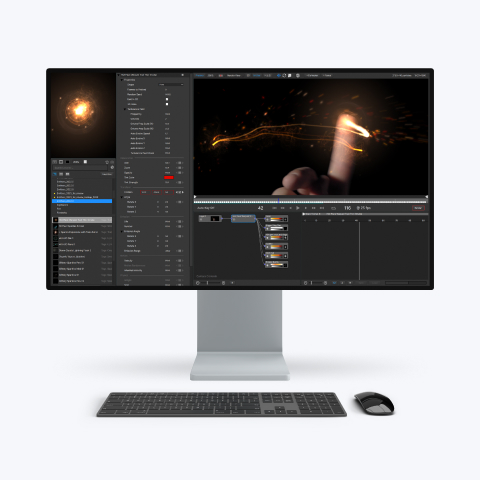
  • particleIllusion 3.0
  • particleIllusion Pro Emitter Libraries
  • After Effects
  • Shake
  • Lightwave 3D

HAL

(Jan 2009)

ParticleIllusion Dust and Debris Help HAL Create Sophisticated Aging Effects Sequences in Low vs. Diamond “Heart Attack” Music Video

HAL, an LA-based visual effects company specializing in film, television, music videos and commercials, recently deployed wondertouch particleIllusion in the creation of the “Heart Attack” music video featuring indie rockers Low vs. Diamond, off of their self-titled album of the same name.

HAL is headed by three-time Emmy-award winner Chris Zapara, a veteran particleIllusion user and enthusiast. Zapara previously used particleIllusion on numerous high profile entertainment projects including the feature film “Hellboy” and the television shows, “Star Trek Enterprise,” and “Battlestar Galactica” while working at leading visual effects facilities Eden FX and Zoic Studios.

The “Heart Attack” video (watch on YouTube: http://www.youtube.com/watch?v=OEjkskR03o0) is directed by Marc Klasfeld, founder of Rockhard films, and focuses on Low vs. Diamond lead singer, Lucas Field and a beautiful young woman, as they look deeply into each other’s eyes and kiss passionately while he sings to her. Throughout the 3 and ½ minute video, their two faces remain in close-up profile and are gradually portrayed in detailed progression as they age from their youth ultimately through old age; culminating in a spectacular and complicated scene where their aged faces crack and fall away.

Low vs. Diamond 'Heart Attack'

Meeting the director’s vision to realistically age two people in close-up over the course of several minutes posed numerous challenges that required the HAL team to explore a number of aging looks throughout production. Zapara commented that particleIllusion was an extremely strong workhorse tool deployed mainly towards the final stages of production to trace the cracks on the characters faces as they formed, releasing dust and debris. Later, as large pieces of the faces fall away, they used large emitters to create layers of cascading dust and debris that fall away to reveal their younger selves.

“Among the biggest issues we faced aging the characters throughout the video were tracking and connectivity.  While we knew we would be doing some complicated tracking involving multiple moving plates, the extreme close-up angle added a level of refinement that made the process much harder than we first thought,” added Zapara.  “The real challenge came when we started making the transitions longer and longer, eventually bleeding into each other and found that a change in one small part of the video would have a ripple effect that runs several seconds across the timeline. There were several spots where we originally planned on collapsing the effects back to raw plates to act as a 'reset' button for any mistakes but we quickly discovered we had to carry our effects--warts and all --through huge transitions.”

Low vs. Diamond 'Heart Attack'

The “face-cracking” transition marked the point in the project where HAL could begin to deploy particleIllusion for the requisite choreographed smoke and debris. To achieve the final and desired aging effects particleIllusion renders were imported into After Effects for precomping and then into Shake for the final comp, and layered with real and other CG elements.  For the falling dust cascades, raw Lightwave renders were used in particleIllusion as a background sequence to facilitate the choreography.

“particleIllusion is one of the first tools I call on to create dust and debris effects, especially on a 2D project like this one. Using the software allowed us to time-out the transitions quickly with the dust included, which became increasingly useful as we explored additional timings and looks,” Zapara explained.  “Because we made so many changes, it would have been very difficult to set up and render so many iterations in a 3D package, or coax practical elements into looking like you wanted them to.”

Low vs. Diamond 'Heart Attack'

particleIllusion also proved useful to the HAL team early on in creating several previzualizations for the director, which were integrated with filmed dust elements in After Effects.

“Our initial aging approaches ended up feeling macabre, which is not the feeling the director wanted to portray. Backing off on the greys and removing most of the dust, however, put us back in the area of needing more fidelity and adding more detail to the cracking pieces than we had time to prepare for.  We threw around several materials as touchstones: porcelain, dried mud, cigarette ash, plaster.  In every case, the biggest problem wasn't duplicating the materials, but rather conveying death without being morbid or gruesome. This required several iterations of choreographed dust, debris, and pieces falling.  Being able to trace a crack in particleIllusion, and to be able to change the size of debris, the thickness of the dust, and the explosiveness of a virtual squib on the fly was invaluable.

Low vs. Diamond 'Heart Attack'

“For me, the biggest advantages of particleIllusion are its quality to speed ratio, and the ease of changing an effect as it evolves.  While we relied on particleIllusion to generate many of the final elements you see in the video, its biggest asset was in creating the several iterations that, for one reason or another, did not make it to the final cut.  We would not have had time to try the 'overwhelming dust' approach, or the 'tiny explosions' approach, or the 'flaky pieces' approach had we not had particleIllusion to quickly generate them for vetting.”