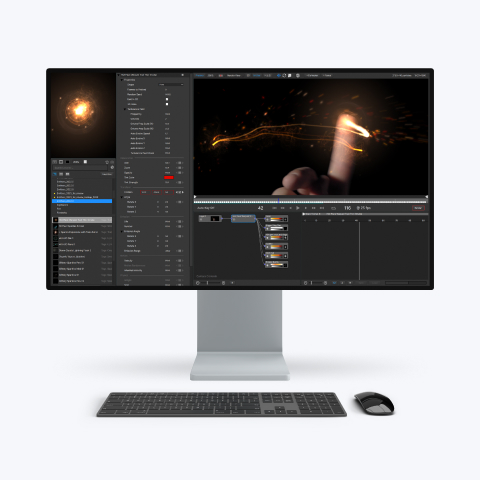
examples:
movies
emitter samples
customer highlights
Read the stories of our
customers and how they
have used particleIllusion
customer quotes
See what our customers are
saying about our products
tv & film projects
A list of the projects
that particleIllusion
has been used in: film,
TV, commercials, games

Chris Zapara, Zoic Studios

(June 2006)

Chris Zapara is currently a Digital Effects Supervisor at Zoic Studios in Los Angeles in charge of the hit television series, "Battlestar Galactica," and a long time user of wondertouch particleIllusion. Zapara is multi award-winning artist. He received two Emmy awards for his work on the "Dune" miniseries titles for the Sci-Fi Channel - "Dune" and "Children of Dune." He also won an Emmy for his effects contributions to "Star Trek: Enterprise." In addition, he worked on Emmy-winning episodes of "Star Trek Voyager" and "Lost." Additionally he received an Emmy nomination for the finale of "Buffy the Vampire Slayer," for which he also received a Visual Effects Society Award for the show. On the film front, Chris has contributed visual effects to "Serenity," "Hellboy," "Hart's War," "Mimic II," "A Painted House," and "The Flamingo Rising." For the really big screen, Chris and his partner Judith have produced planetarium and museum shows in the IMAX format.

Zoic Studios is a leading producer of visual effects and CG animation for commercials, feature films and episodic television. The company's credits include the Joss Whedon-directed feature film "Serenity," episodics including "CSI: Miami," and "Battlestar Galactica" as well as award-winning commercials for Mini Cooper, HP and Playstation2. www.zoicstudios.com


particleIllusion has now been adopted into the Zoic pipeline in its Artistic Productivity Unit where it was used most recently during the second season of the hit series, "Battlestar Gallactica;" most prominently in the final episode.

"We relied on the new particleIllusion Professional Emitters (Pro Emitters) package for several heavily layered shots in the finale in which a character detonates a nuclear warhead inside the Cloud Nine space ship that destroys the liner in the blast. Several other nearby ships are also destroyed by the shockwave. My goal was to improve upon an established look for the blast," said Zapara.

To successfully portray the ship ripping apart in the nuclear blast, Zapara's team used a combination of 3d animation layered with several Pro Emitters. "This sequence might have been a cumbersome and render heavy 3D pass. With access to the Pro Emitters effects library we could quickly add in smaller details of the destruction the blast causes such as the millions of glass shards from the erupting dome on the ship as well as thousands of tiny debris pieces to augment the larger, 3D pieces we ripped from the actual model, which gave the shot scale. Additionally, we also used particleIllusion to choreograph specific 'arms' of plasma, fire and smoke, which we heavily augmented with real elements and 3D volumetrics. This was also done for the ships surrounding Cloud Nine that were destroyed.

"In this sense, particleIllusion was very handy as a 'guide' for the compositor, as well as a texture layer to modulate the other elements. Working with an AfterEffects import path import also came in handy." Zapara further explains that particleIllusion was also used in the second half of the sequence, where the blast destroying several nearby ships is evident. "While we could have created fire, smoke and debris streaming off of these ships in 3D, I was able to generate several passes of particleIllusion elements in a couple of hours rather than having my team spend a couple of days collectively.


"Overall, particleIllusion comes in very handy as a 'bridge' between pure 2D filmed elements and pure 3D volumetrics and particles. The former are by default more realistic, but are limited by the context they were filmed in. The later are heavily controllable, especially in three dimensions, but are cumbersome and expensive," adds Zapara. "While we can use 3D elements for complicated moves, the 3D approach is typically too expensive from a cost and rendering standpoint. particleIllusion is a middle ground solution enabling us to easily generate effects that blend into the filmed elements, but with the advantage that we can animate them. It allows our artists more time to focus on the shot as a whole.